

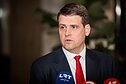








Žygimantas Matekonis is one of the few Lithuanians fighting in Ukraine. After enduring a month at Kherson's frontlines, he was wounded. In an exclusive interview with LRT.lt, Matekonis talks about the fighting in southern Ukraine and his own warpath.
Read the original in Lithuanian here.
In December, Matekonis was treated in Kyiv for his head injury – contusion. With artillery dominating the fighting, it is one of the most common injuries caused by nearby explosions. The consequences can be severe – memory and psychological disorders, speech and hearing difficulties, and other long-term damage.
However, after a month of rehabilitation, Matekonis went back to the frontline to fight alongside another Lithuanian volunteer at the Territorial Defence Forces. This interview, edited and abridged, took place a few weeks before his second departure for combat.
How long have you been in Ukraine?
We came with the first mission to train Ukrainians seven months ago. But it didn't stick to my heart, I'd rather fight myself. I decided to go to a combat battalion with a few colleagues. After four or five months of training, we were ordered to the front.

It must have been interesting for you to witness how the volunteers of the Territorial Defence Forces turned from civilians with weapons into professional soldiers?
Yes, it was a difficult start, because the Ukrainians did not expect that the Russians would start attacking. There was confusion at the beginning, but after Ukrainians had recaptured all the territories around Kyiv, they started to build up professional combat units.
You are part of probably one of the first professionally formed territorial defence units?
Yes, that battalion was previously called the 11th Special Purpose Company. They were doing well from the beginning of the war. With only a few casualties, they were knocking out columns of orcs [Russians]. That's what it evolved from and now we have a whole battalion.
When you were deployed in the south, what was the fighting there like?
We came in a convoy straight from Kyiv. A commander [of the unit] that we had to replace presented the situation, telling us what you could do, what you couldn't do, and what was strictly forbidden because you would get shelled. For example, driving with the lights on, smoking, or putting any light on. We immediately switched off our phones and geolocation.
We don't even take pistols to the positions, much less the phone. A pistol is just an extra weight that is simply not needed. If you have optical sights on the guns, you put everything away because when the shelling starts, you're going to smash everything in the trenches. You have to walk a kilometre and a half to get to the position, you are carrying a lot of water, food and things to warm up that food. Plus, warm clothing, because it's bitterly cold at night.
You work constantly, if one sleeps, the other observes everything with a thermal imaging camera at night and with binoculars during the day. You watch and listen. There are around 800 metres between positions, but there are places where it is 400 or 500 metres. So if you sneeze, someone will say “bless you”.
We didn't fire our guns once. They shelled us from a distance with artillery, Grad rockets, phosphorus [ammunition], and cluster munitions. They had everything, and we had only the 122mm mortars.
You can hear the tank shells flying over you, the mortars whistling. You hear it all the time, but you sit and watch, sit and watch, sit and watch. If you hear that it is coming towards you, then you duck down in the trenches, you wait until it's over. Once it passes, you come out again, you watch again.

You said that after a month the shelling decreased. Was it because the Ukrainians started destroying Russian warehouses and supplies?
This was just before the Russian retreat from Kherson. I think they were already slowly thinking of withdrawing their main forces. It was very noticeable when they were going all out at first and then the shelling got less and less. No more phosphorus, no more Grad rockets, just mortars and AGS [automatic grenade launcher].
My opinion is that they were probably [already] withdrawing forces, because a week after I received the contusion, news came that Kherson had been liberated.
Was it a shame for you that you weren’t there?
It's was a shame, really a shame. They [our troops] were doing clean-up operations.
Did they run into Russian forces?
No, everyone had already fled. There were shells left behind, there was plenty of ammunition. As usual, they just gathered their cars and left.
It is strange that they retreated so suddenly, because they held their position well. They were [shelling] us all the time, and we didn't even have anything except mortars. They [the Russians] were hitting us very well, because they had been sitting there for months, they had adjusted to their targets very well. We would have required not only aviation but also good artillery to push them out, but we had nothing.
It also would have been impossible [to attack that position directly]. If we went up to them, we would have gone straight for the meat grinder. Plus there were mines all around

Before joining the fighting, you first trained others, then trained yourself. Was there anything that surprised you once you got to the frontline?
When you come to the front, you realise that this is not training, not a game. When the first shells fall close to you, even if they are 500 metres or a kilometre away, you start to take things seriously.
When we first heard Russian shelling, their guns firing toward us, we immediately dropped down like Legos. We worked together beautifully, maybe [because of this training] we took no casualties.
Later, one man died in a car accident and another one was killed by shrapnel at the trenches. He was sitting, smoking, not realising that he was in a real war. A tank covers 2 or 3 kilometres and it probably saw him. When the guys came to pick him up, he was still sitting like that, in the sun, [killed by shrapnel]. He didn't even realise what had happened.
How were you injured?
In our company, we rotate every four days. It was our turn, my fourth deployment to the trenches. The day before, we destroyed a tank, so we were happy.
After spending two days in the trenches, we were going back, just walking along the road to our evacuation point where the evacuation group was supposed to pick us up. And as we were walking about 800 metres away from our positions, three shots from the AGS [automatic grenade launcher] landed near us.

Because there was constant shelling, we thought that it was just a coincidence. We walked another 100 or 200 metres, and there were three exits [shots] and they landed around us.
What saved us was that there was a concrete canal next to the road. We were lucky that the artillery didn’t hit us, because if it did, there would have been more than a few people injured.
We then piled into a large pipe running under the road, one on top of the other. It didn’t matter anymore - dirty, not dirty, rats, no rats.
The extraction team could not pick us up, and I saw that [the Russians] were also hitting our evacuation point because they already knew that a car had to come there. After we had retreated about 3 kilometres, it was calmer. But anyway, the tension remained.
When the shelling stopped, we walked back to base, the adrenaline was high, we were telling each other stories, laughing, and so on. The next day I got up, and my head was like it was hit with a hammer, you just didn’t know what was going on. The pain was all over.
In our company of a hundred people, six received contusions. Basically, six people, half of the group were taken out.
When they saw that there was something wrong with us, they took us to a military hospital in Mykolaiv.

What is the situation at the military hospital?
They examined us and admitted us for a couple of days. More serious patients were coming there all the time, with shrapnel injuries, so they sent us to Odessa to free up space. We were there for 22 days.
The conditions at the military hospital in Mykolaiv were bad, the place looked a bit like the hospitals during the Second World War. If you wanted to have an IV, you had to lie down in the corridor. There was very little space, there were eight people in one ward, and you almost had to walk over each other to get to your bed.
The staff was small, only military medics. The conditions there were very strict, and if you went to the wrong place to smoke, you were immediately fined. You could not leave the area. There was one man in the ward who came in with shrapnel all over him, and you could hear him moaning at night.
Then when we went to Odessa, the conditions there were like in a good clinic in Vilnius. The staff is just golden, whatever you need, you just tell them and they get it right away. As soon as we arrived, we were immediately given new clothes, massages, everything.
In Odessa, nobody was watching over you, if you wanted to go for a walk and the doctor let you, you could even go to the city. When relatives came, you could even spend the night outside. In Odessa, they understand people more than in the military hospital there.

Now part of my rehabilitation is spending time with my girlfriend, part of the time I go for massages. I also try to physically rebuild myself again so that I can go back to the front.
There were also all kinds of talks with a psychologist, because the first few nights I could forget about sleeping because of all the pain. They [psychologists] also look at your memory. That's what they see [if there are post-traumatic effects].
What's next for you?
Once you get into that rhythm of war, you feel like you can’t live without it anymore. There are times when you're sick of it and you want to go back somewhere to rest. But that's the thing – when you're at home, you really miss all that adrenaline. I don't even know how to explain it. You miss your friends from the battlefield.
You are here in Kyiv and you don't know what's going on with your friends, maybe they are being slaughtered over there, you want to go there, to support them. You want to be with them.

Newsletter
Every Friday morning.